Why Timing Matters More Than Destination When Traveling with Children

There is a conversation I have often, usually early in a planning engagement, when a parent tells me they want to take their three year old to Paris because they have always wanted to walk the Seine as a family. I understand the impulse completely. The image is beautiful. The intention is sincere. And yet, in almost every case, the trip those parents actually need is a different one than the one they are imagining. The gap between what we hope a family trip will do and what it can realistically deliver at a given age is one of the most overlooked dimensions of family travel. Destination gets almost all of the attention. Timing, by which I mean the timing of the children’s lives rather than the season, often gets very little.

Over eighteen years of designing journeys for families, I have come to believe that when you travel with children matters more than where you take them. A thoughtfully chosen destination at the wrong developmental stage can produce a difficult, expensive, and mostly forgotten experience. A modest destination at the right stage can shape a child for life. The research on how children form and retain memories supports this more strongly than most parents realize, and the experiential differences across life stages are real enough that any serious planning conversation has to account for them.

The Quiet Truth About the Earliest Years

Parents of infants and toddlers often feel pressure, whether from social media or from their own internal narrative, to demonstrate that having young children has not changed their capacity for meaningful travel. The grand European trip with a one year old becomes a kind of statement. The reality, as most parents eventually concede in private, is that trips in this stage are almost entirely for the adults. That is not a criticism. It is simply worth naming clearly.

Research on early childhood memory is consistent on this point. Most adults retain no specific memories from before roughly age three, and even the memories children do form in these years tend to fade or become unreliable over time. Science magazine has covered this extensively in its reporting on infantile amnesia, noting that a toddler’s brilliant morning at the Trevi Fountain is almost certainly not going to survive into their adult recollection. What endures are the photographs and the stories other people tell them later. A useful overview of the research is available at Science magazine.

For the 0 to 3 window, the most honest planning conversation focuses on parental well-being rather than enrichment for the child. Short-haul destinations, strong healthcare infrastructure, established resort properties with predictable logistics, and itineraries built around the child’s sleep rhythms tend to produce the best trips. The Caribbean, Costa Rica, and select resort regions of Mexico work well precisely because they allow parents to rest while the child’s routine is disrupted as little as possible. This is not a lesser form of travel. It is a different one, designed around a different goal.

Where Wonder Begins

Between roughly age four and six, something shifts. Children in this range begin forming memories that have a reasonable chance of persisting into adulthood, and the way they form those memories is sensory and emotional rather than analytical. They remember the surprise of a peacock walking past their breakfast table. They remember the feel of cold water on bare feet. They do not, in any meaningful sense, remember cultural context, historical significance, or the architectural distinction of a given building.

This is the age at which theme parks, aquariums, interactive museums, and simple nature experiences tend to produce the strongest return on parental effort. Attention spans remain short, often under an hour for any single activity, which means itineraries need to move in rhythm with the child rather than ahead of them. Trying to walk a four year old through a full day of cultural sightseeing in Rome is usually a quiet misery for everyone involved. The same child on a gentle Swiss farm stay, or at a well-chosen family resort in Portugal, may retain flashes of those days into their thirties. Parents who arrive at this stage having already absorbed the lesson from their toddler years tend to plan with more realism and enjoy the trips more deeply.

The Window Most Families Underestimate

Ages seven through eleven are widely regarded within the travel industry as the sweet spot for family travel, and I share that view with few reservations. Boutique agencies that specialize in family work have long observed that children between roughly eight and twelve combine improved attention spans, growing curiosity, and physical stamina in a way that opens up entirely new categories of destination.

Children in this window can walk the length of a cultural city without meltdowns. They can sit through a meal in a restaurant that does not involve chicken fingers. They can absorb history when it is told well, engage with wildlife when it is presented thoughtfully, and carry their own small role in the rhythm of a journey. Rome begins to make sense to them. London reveals itself through stories rather than fatigue. National parks become settings for genuine discovery rather than logistical endurance tests. The Scottish Highlands, the Italian lakes, and the ruins of the Peloponnese all open up in ways they simply cannot for younger children.

What parents often underestimate is how brief this window is. A child who is ten today will be thirteen sooner than feels reasonable, and the nature of family travel changes substantially when adolescence arrives. The families I work with who plan carefully in this stage tend to emerge on the other side with a body of shared experience that supports the relationship through the harder years ahead. The trips taken between eight and eleven become reference points for an entire family, returned to in conversation for decades.

When the Traveler Becomes a Partner

Adolescent travel is fundamentally different, and the parents who do not recognize the shift tend to struggle with it. A thirteen year old is not a larger version of an eight year old. They are a person developing their own identity, their own preferences, and their own sense of what makes a trip worth their time. Treating them as a passenger on a journey designed entirely by the adults is the most common error I see at this stage, and it often produces the strained, screen-dominated trips that families describe to me in retrospect with some regret.

The better approach is to treat the teenager as a co-designer. This does not mean handing them the itinerary. It means involving them meaningfully in the choice of destination, the structure of days, and the activities that will define the trip. Adventure travel, from skiing in the Alps to diving in the South Pacific, works well here because it offers challenge and autonomy. Cultural immersion, particularly when it includes food, music, or creative pursuits the teenager already cares about, can produce genuine transformation. A teenager who has always photographed their world will travel differently through Iceland than one who has been told that Iceland is beautiful and should be appreciated.

The Pitfall of Parent-Centered Planning

The most common planning error across all of these stages is what I think of privately as parent-centered planning disguised as family travel. The parents choose a destination they have long wanted to visit, build an itinerary around adult interests, and then attempt to make it work for children who are not developmentally aligned with it. The result is almost always a trip of compromises, with the children bored or overwhelmed and the parents frustrated that the experience is not matching their imagination.

The honest alternative is to design each family trip around the actual developmental realities of the children traveling, and to save certain destinations for the stages in which they will land. Venice will still be there when the children are ten. The vineyards of Burgundy will still be there when they are seventeen. Holding a destination in reserve until it can genuinely be shared is one of the most generous planning decisions a parent can make, and it often produces the trip they were imagining all along, simply postponed by a few years.

When the Ages Are Mixed

The question I am asked most often is how to plan a trip when the children span a wide age range, particularly when a younger child of four or five is traveling with a teenager of fourteen or fifteen. This is one of the more nuanced design problems in family travel, and it is solvable, but only with deliberate structure. The core principle is that a single itinerary designed to please both children usually pleases neither. The better approach is to choose a destination with enough range to hold genuinely different experiences within the same base, and then build intentional separation into the days.

Properties that offer supervised children’s programming alongside serious adult or teen activities become essential in this scenario. Certain resorts in the Caribbean and in Costa Rica do this exceptionally well, allowing a younger child to spend mornings in a naturalist program while a teenager is on the water with an instructor and parents take time for themselves. Cultural destinations can also work, provided the itinerary is built with two parallel tracks rather than one forced compromise. The families who approach mixed-age travel with this kind of structural clarity tend to enjoy the trips most. The ones who try to build a single blended experience often find that the younger child is exhausted by mid-afternoon and the teenager has spent the entire trip waiting.

What All of This Means

The families who come to us most ready for a good trip are those who have stopped asking where they should go and started asking when the trip they are imagining will actually land. That is not a small reframing. It is the difference between a journey that becomes part of a family’s shared story and one that becomes a cautionary tale about the Louvre with a toddler. Developmental stages are real. Memory formation is real. The attention spans, stamina, and emotional readiness of children at different ages are real. A good family trip is built in full acknowledgment of those realities rather than in opposition to them.

Destinations are remarkably patient. They wait. Children, on the other hand, move through their stages quickly, and the window for any given kind of trip closes more abruptly than parents expect. The art of family travel design, from my vantage, is recognizing which window is open right now and building the trip that belongs in it.

If you are thinking about a family journey and want to consider the right timing as carefully as the right destination, an intentional conversation is often the most meaningful place to begin. Good family travel is not assembled from top-rated experiences. It is designed through honest discussion of pacing, developmental fit, and the trade-offs that come with every stage.

You are welcome to reach out through AAV Travel or contact us directly at info@aav-travel.com to start a thoughtful planning conversation.

Written by: Stefanie P.

The Thinking Traveler’s Case for a Guide: On Terrain, Weather, and What You Miss

There is a particular kind of traveler who has done enough hiking to feel reasonably self-sufficient in unfamiliar terrain. They know how to dress for weather, read a map, and manage their own pace. They are not looking for someone to hold their hand. What they are looking for is a trip that delivers on its full promise rather than only a partial version of it.

For that traveler, guided hiking is not about limitation. It is a considered choice, made when the environment is genuinely complex and the value of local expertise outweighs the satisfaction of pure independence. The Scottish Highlands and the Swiss Alps are exactly the kind of settings where that calculation tends to resolve clearly. Not because either landscape is prohibitive, but because both are layered in ways that reward informed knowledge far beyond what most experienced travelers anticipate before they arrive.

What the Weather Actually Does in the Scottish Highlands

Those who have spent time in the Highlands know that forecasts carry a certain optimism that the mountains do not always honor. Conditions change with a speed and completeness that can be genuinely disorienting. A clear morning gives way to low cloud and reduced visibility within an hour, and anyone who has walked a ridge in sudden mist understands that the trail seeming obvious from below becomes a much more interpretive exercise once the landmarks disappear.

What I have observed in these moments, hiking alongside guides with long familiarity with the terrain, is not alarm. It is quiet adjustment. A good guide reads the environment continuously, not just at the trailhead. They notice shifts in light quality, changes in wind direction, the particular way cloud is building across a hillside. All of it carries information that is genuinely useful, and they respond to it without drawing attention to the response. The route may not change. The pacing might. A rest that seemed optional becomes deliberate. A conversation shifts to what is immediately in front of you, and that conversation is worth more than it would have been in clearer conditions.

This is also where the value of a guide begins to reveal itself in ways that have nothing to do with navigation. A guide who knows the Highlands well knows where red deer tend to move at dusk, which loch sides hold the oldest Scots pines, and what the ruins on a distant hillside were before they became an atmospheric backdrop. The hiking becomes a conversation with the landscape rather than a traverse of it. That distinction is not small. It is, for many travelers, the difference between a long walk and a genuinely memorable experience.

What the Alps Ask of a Traveler

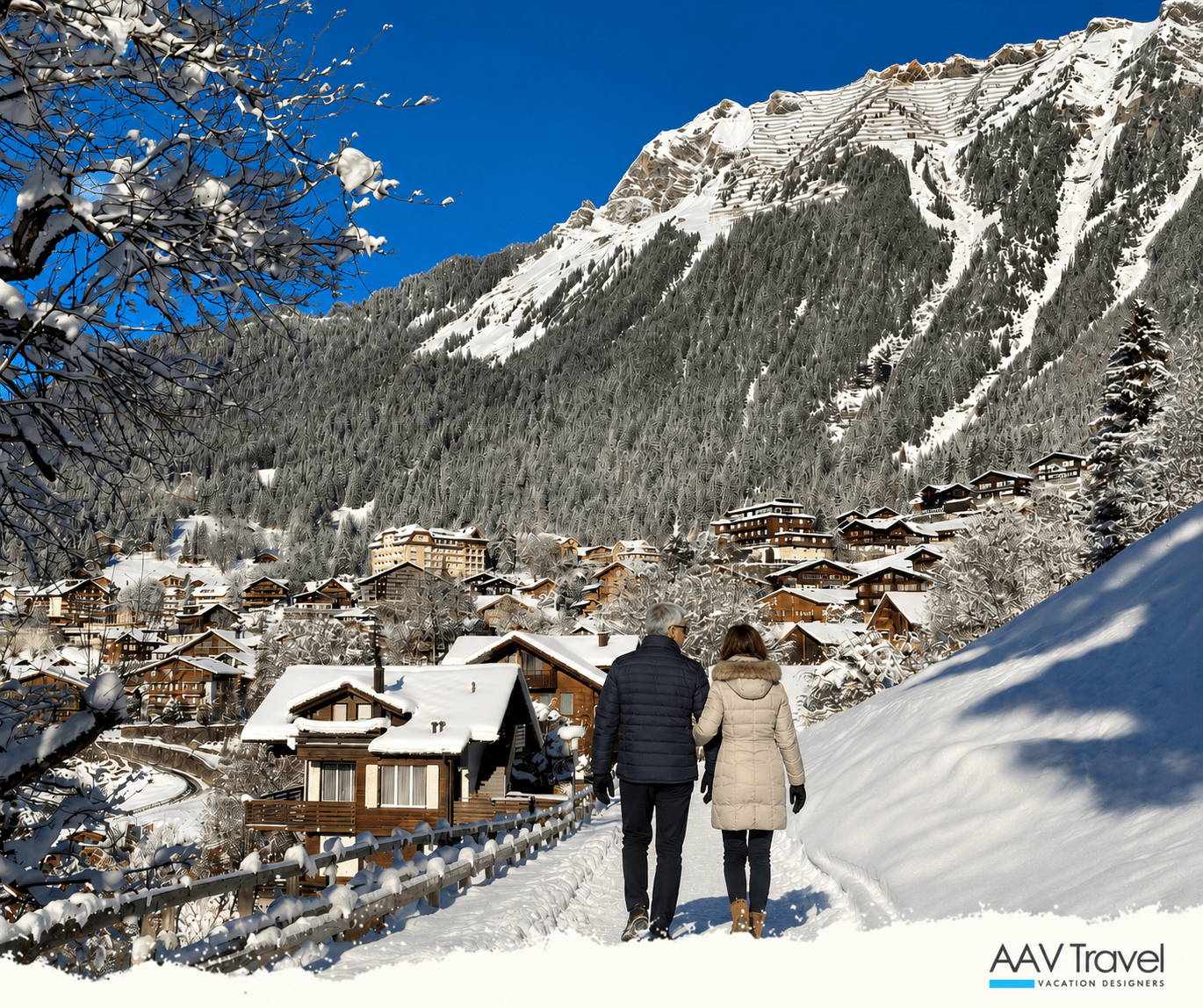
The Swiss Alps introduce a different set of variables. The scale is immediate, and the terrain is less forgiving than it appears from valley level. Elevation gain that looks moderate on a map can involve sustained technical effort at altitude, where the air is thinner and the body adjusts more slowly than most people expect. The consequence is rarely dramatic, but it is consistent: travelers who push harder than their acclimatization supports tend to arrive at the most extraordinary viewpoints feeling depleted rather than expansive.

A knowledgeable guide calibrates this without making it the subject of conversation. The pacing simply feels right. Rest comes at the moments when the body is ready for it, before fatigue has accumulated rather than after it has set in. The route unfolds in a way that builds steadily rather than demands abruptly. That design is largely invisible when it is working well, and you tend to notice it most when comparing a well-guided day against one that was not.

There is also the question of route confidence. Trails in the Alps fork frequently, and the signage, while generally reliable, requires local interpretation. Some paths suit certain fitness levels and objectives far better than others, and the decision of which fork to take involves knowledge of what lies ahead that a guidebook cannot reliably provide. Traveling with someone who has made that decision dozens of times changes the whole character of the day. It allows a traveler to push further than they might have dared alone, because the edge of what is manageable is being held steady by someone who understands where it is.

I have watched this happen. In fact, it has happened to me, a Swiss, who is used to hiking the Alps. A traveler arriving at a trailhead genuinely uncertain whether they could complete a particular route, working with a trusted guide who adjusted the approach incrementally, finishing with something that felt earned in the deepest sense. That is not luck. It is design.

What a Guide Notices That a Traveler Cannot

There is an aspect of guided hiking that rarely appears in the practical conversation about it, perhaps because it is harder to quantify. A guide with genuine depth brings contextual knowledge that quietly transforms the experience without announcing itself. This is not the scripted narration of a group tour. It is closer to walking with someone who has thought carefully about a place over many years and shares that thinking naturally, in response to what is immediately in front of you.

In the Highlands, that might mean understanding the geologic history of a particular glen, knowing the seasonal movements of certain bird species, or being able to explain why a stone dyke running across open moorland was built exactly where it was and by whom. In the Alps, it might mean tracing the relationship between a village and the high pastures above it, or identifying a wildflower that carries a local name and a traditional use that appears in no guidebook written for visitors.

This kind of knowledge is not available on a trail map. It is accumulated through sustained time spent in a place with genuine attention, and it is one of the clearest arguments for traveling with a guide who has truly earned their understanding of a landscape rather than simply acquired a qualification to lead people through it. The difference between the two is significant, and experienced travelers generally sense it within the first hour on the trail.

A Refinement, Not a Concession

Guided hiking is not the right choice for every trail or every traveler. A well-marked path through familiar terrain, walked on a clear day with appropriate preparation, asks nothing more than a traveler’s own judgment. But terrain like the Highlands or the Alps introduces a genuine complexity that shifts the equation. These are environments where the variables are real, where local knowledge operates at a different level than general competence, and where the experience available to a well-supported traveler is qualitatively different from what independent hiking can provide.

For travelers who have hiked before and are now considering terrain that is genuinely new, or who want to push into something more physically or mentally demanding than their previous experience, this is not a question of capability. It is a question of how they want to allocate their attention. Managing uncertainty in an unfamiliar environment requires cognitive effort. Handing that effort to someone who is genuinely qualified to carry it frees the traveler to do something more interesting: actually be present in an extraordinary place.

That, in the end, is the most accurate description of what a good guide provides. Not safety as an abstraction, not reassurance, not the removal of all uncertainty. But the quiet management of variables that would otherwise occupy the foreground, creating enough space for the traveler to engage with the landscape at the level it deserves. In a setting like the Scottish Highlands or the Swiss Alps, that space is worth something. It is, for many travelers, what the trip was actually for.

If you are considering a hiking journey in the Scottish Highlands, the Swiss Alps, or another landscape that calls for thoughtful planning and trusted local expertise, the itinerary conversation is worth having before the logistics are set. AAV Travel works with a network of trusted partners whose knowledge of their terrain is the kind that only comes from years of sustained attention. You are welcome to reach out directly at info@aav-travel.com to begin a thoughtful conversation about how the right expertise can shape your journey from the very first step.

Written by: Stefanie P.

From Page to Place: Designing Travel Inspired by the Books You Love

Travel is often described in terms of destinations. Paris, Tuscany, the Amalfi Coast. Places are listed, compared, and checked off. Yet some of the most meaningful journeys begin much earlier, often with a book. A place comes to life on the page so vividly that it feels almost familiar before you have ever been there. Long before any plans are made, the experience has already begun to take shape in your imagination.

The Quiet Influence of a Story

A well told story has a way of shaping our imagination. Through the pages of a novel or memoir, we begin to picture the rhythm of daily life, the light at a certain time of day, the way people gather, eat, and move through a place. Over time, that imagined version of a destination becomes something more personal. It creates a quiet pull. You are no longer simply interested in visiting. You want to experience it for yourself, to walk those streets, sit in those cafés, and see how closely reality meets the version you have carried in your mind.

A hillside in Provence feels different when you recall the quiet, sunlit rhythm described by Peter Mayle. A café in Paris carries a different weight when you imagine Hemingway sitting nearby, observing the world with careful attention. A villa in Tuscany becomes more than a beautiful setting when it reflects the personal transformation captured by Frances Mayes.

More Than a Backdrop

This is part of what makes journeys inspired by literature, history, or personal connection so enduring. The places themselves are not just backdrops. They shape atmosphere, perspective, and memory. Travelers are drawn to them not simply to visit, but to feel them. The warmth of late afternoon light across a vineyard, the hum of conversation spilling from a small restaurant, the stillness of a countryside morning. These are experiences layered with meaning, shaped as much by context as by location.

Approaching travel through this lens changes how a journey is designed. Instead of asking what there is to see, the question becomes what story you want to step into. For some, it may be a literary path, moving through regions that have long lived in the imagination. For others, it may be a historical thread, tracing a particular period across multiple places. It can also be deeply personal, shaped by family heritage, a long held curiosity, or a subject that has quietly held your interest for years.

Connecting the Journey

What becomes clear is that narrative naturally introduces a different pace. When a journey is anchored in meaning, there is less urgency to move quickly. Time is allowed for observation, for atmosphere, for the subtle details that would otherwise be overlooked. A morning spent in a local market becomes more than a visit. An afternoon walk through a neighborhood becomes a way of understanding context. The experience unfolds gradually, rather than being compressed into a series of highlights.

This also shifts the role of each destination within an itinerary. Instead of competing for attention, places begin to connect. A city is no longer an isolated stop, but part of a broader arc. The transition between locations matters. The sequence matters. Even the time of year can influence how the story is experienced. These are the kinds of decisions that quietly shape how a journey feels, often more than the individual elements themselves.

There is also a certain calm that comes from traveling this way. When the purpose of a trip is grounded in something meaningful, there is less pressure to maximize every moment. The experience becomes more intuitive, more reflective. Travelers often find that they remember not just what they saw, but how it all fit together. The sense of place becomes clearer, more cohesive.

A Natural Evolution for Experienced Travelers

For experienced travelers, this approach often feels like a natural evolution. After years of visiting well known destinations, the question shifts from where to go to how to experience it differently. Narrative offers a way to deepen familiar places or to discover new ones with greater intention. It moves travel away from repetition and toward something more personal and considered.

Designing a journey in this way requires discernment. It involves understanding not just the destination, but how its layers come together. It requires thought around pacing, context, and how each element contributes to the overall experience. When done well, the result is not simply a well planned trip, but a journey that feels coherent and quietly memorable.

Starting with What Stays With You

If you are beginning to think about travel in this way, it can be helpful to start with a simple question. What has stayed with you over time? A book, a place, a moment of curiosity. From there, a journey can begin to take shape, one that reflects not just where you want to go, but why it matters.

At AAV Travel, this is often where the most meaningful journeys begin. Through a thoughtful conversation, we explore what draws you to a place and how it can be experienced with the right balance of context, pacing, and insight. If you are considering a journey shaped by story, you are always welcome to reach out at AAV Travel or info@aav-travel.com to begin that conversation.

Written by: Stefanie P.

The Art of Selective Trust: Why the Best Journeys Begin With Letting Go

There is a particular type of traveler who plans beautifully. They research thoroughly, cross-reference reviews, bookmark restaurants months in advance, and arrive at the airport with color-coded documents and contingency plans for their contingency plans. In their professional lives, this precision has served them well. It has built companies, guided careers, and produced outcomes worth being proud of.

And yet, on the trip itself, something quietly goes wrong. Not logistically. Logistically, things unfold exactly as planned. What goes wrong is subtler. The schedule becomes a constraint. The research becomes a script. The beautiful morning in a medieval village is partially experienced through the filter of whether the next stop will go smoothly. The traveler arrives home rested on paper and quietly exhausted in practice.

Control, when applied to travel with the same intensity it is applied to business, tends to produce a version of the destination rather than the destination itself.

The Illusion of the Perfectly Managed Trip

There is a meaningful difference between being informed and being in command. An informed traveler understands what they want from a journey, what kind of pace suits them, what trade-offs they are willing to make, and what truly matters versus what simply looks good on an itinerary. A traveler attempting to remain in command of every variable is doing something different altogether. They are managing a project.

Travel, at its best, does not behave like a project. It breathes. It offers moments that cannot be scheduled and connections that cannot be engineered. A conversation with a winemaker who decides, spontaneously, to open a bottle that never appears on any list. A morning fog lifting over the Douro Valley at precisely the hour you happened to be sitting on a terrace with your coffee. A sommelier at a small restaurant in Burgundy who, having spoken with you for six minutes, brings something entirely different from what you ordered because he could tell, exactly, what you needed.

These are not accidental moments. They are made possible by the deliberate act of creating space for them.

What Japan Teaches About Trust and Expertise

A well-known observation in hospitality and service design points to Japan as one of the most instructive examples in the world. In Japanese service culture, the customer is not assumed to always know best. Not out of disrespect, but out of genuine expertise. A master craftsman, a seasoned chef, or a deeply trained guide has spent years developing judgment that a visitor, however intelligent and well-prepared, simply does not possess. The expectation of deference flows toward expertise, not toward the paying guest.

This is not a power imbalance. It is a form of respect. It acknowledges that the person who knows the subject most deeply is in the best position to guide the experience. And it produces, in the hands of someone truly skilled, results that the traveler could not have imagined on their own.

The same principle applies to travel design, though it is rarely framed that way in Western contexts where the client is always assumed to be the final authority on their own trip. There is something worth reconsidering in that assumption.

The Real Cost of Overmanaging

When a traveler overmanages a luxury itinerary, the cost is not usually visible. The flight lands, the hotel is beautiful, the driver arrives on time. What is lost is less tangible: the opportunity for the experience to exceed what was anticipated. For something genuinely unexpected to occur within a well-held container.

Luxury travel, at its most effective, is not the elimination of all uncertainty. It is the careful management of risk so that the right kind of openness can exist. An experienced travel advisor does not simply execute logistics. They create conditions for things to go unexpectedly well, which requires a different kind of engagement from the traveler. It requires some degree of trust.

This is a meaningful distinction for travelers who are high-functioning and accustomed to directing outcomes. The ask is not to become passive. It is to redirect the energy that typically goes into control toward something more productive: communicating clearly what matters, being honest about what does not, and then allowing someone with genuine expertise to translate that into a design they could not have built alone.

When Letting Go Produces Better Results

The travelers who tend to describe their trips as transformative are rarely the ones with the most detailed pre-departure research. They are the ones who entered the journey with clarity about what they wanted to feel, and then trusted the people around them to help create that feeling. They did not surrender judgment. They exercised it in a different place. At the beginning, in the design conversation, where it belongs.

A well-designed trip does not require constant intervention from the traveler once it has begun. The structure is already there, built thoughtfully, tested against experience, and calibrated to what the person actually values. When a change occurs, and changes always occur, the advisor is already ahead of it. The traveler does not need to manage the situation. They need only to be present in it.

This is what selective trust looks like in practice. Not blind delegation, not abdication, but choosing deliberately to place confidence in someone who has earned it, so that you can be fully in the experience rather than managing it from a slight remove.

Designing for Openness

The question worth sitting with before any major journey is not how much you know about the destination. It is how much of the experience you are actually willing to receive. Some travelers arrive with every hour accounted for and return home never having been surprised by anything. Others come with a clear sense of what they value, a trusted advisor who understands them well, and enough openness to let the trip become something they could not have planned themselves.

The latter tends to be the more memorable experience. Not because it was less structured. It may have been meticulously structured. But because the structure was held by someone else, someone who understood what it was for and what it was meant to protect.

Expertise is not a service feature. It is a design element. The best journeys are not the ones where the traveler was most in control. They are the ones where control was placed wisely, and then released.

If this way of thinking about travel resonates with you, I would welcome the opportunity to explore what that looks like for your next trip. Through a Strategic Travel Advisory Session with AAV Travel, we can begin with what matters most to you and design from there, with the kind of expertise and judgment that transforms a well-planned trip into an experience that genuinely exceeds expectation. Reach out at info@aav-travel.com to begin the conversation.

Written by: Stefanie P.