A Shorter Trip Doesn’t Have to Feel Like Less of a Journey

Somewhere along the line, many of us absorbed the idea that a proper international trip requires two weeks. Ten days at the very least. Anything shorter feels like shortchanging the destination, so the whole thing gets postponed to a year when the calendar might finally cooperate. Those years have a way of not arriving.

The travelers I work with rarely lack the means to stay longer. They lack the window. A business that needs them. Parents who need them. Sometimes a preference for being home after a week away, even when nothing at home is asking. Seven or eight nights is often what the year realistically offers, and the more useful question is what to do with them.

Time as its own kind of luxury

Luxury travel is usually discussed in terms of what money buys. The better cabin, the better suite, the private guide. Time sits outside that arithmetic. A traveler may be perfectly capable of paying for twelve nights in Europe and still only want to be away for seven. Once that is true, the planning question changes shape. It stops being how much can we fit into a week, and becomes what would make this week worth the leaving of home. Those two questions produce very different trips.

What happens when short trips go wrong

The reflex, when time is limited, is to compress. Take the itinerary built for twelve nights and squeeze it into seven. Three cities, four hotels, a rail segment, an internal flight. It looks efficient on paper. On the ground, it often behaves differently. Every hotel change eats the better part of a morning: packing, checking out, transferring, arriving, waiting for a room. Every flight costs far more than its published duration once you add the airport on either end. In a seven night trip, two changes of base can consume a surprising amount of the time you thought you had. That is time spent moving between things, and moving between things is rarely the part travelers talk about later.

Valetta Promenade

Subtracting destinations, rather than adding them, tends to feel counterintuitive. It looks like doing less. What it actually does is create room for what no schedule can produce. Returning to a restaurant you liked. A second coffee at the café where the owner now recognizes you. A museum visit that runs long because one room deserved it. An afternoon surrendered to the weather. In my experience, these are often the moments travelers tell me about later, and they need empty space in which to occur.

Choosing the anchor before the destination

A better approach is to decide what a trip is for before deciding where it goes. The anchor might be a wine region you have wanted to understand properly, a stretch of coast for walking, a family thread that leads back to a particular county, a milestone that deserves marking somewhere worthy of it. Once the anchor is clear, other decisions begin to make themselves, and the destination follows the reason for going rather than becoming a set of famous places that happen to share a map.

Geography as a design decision

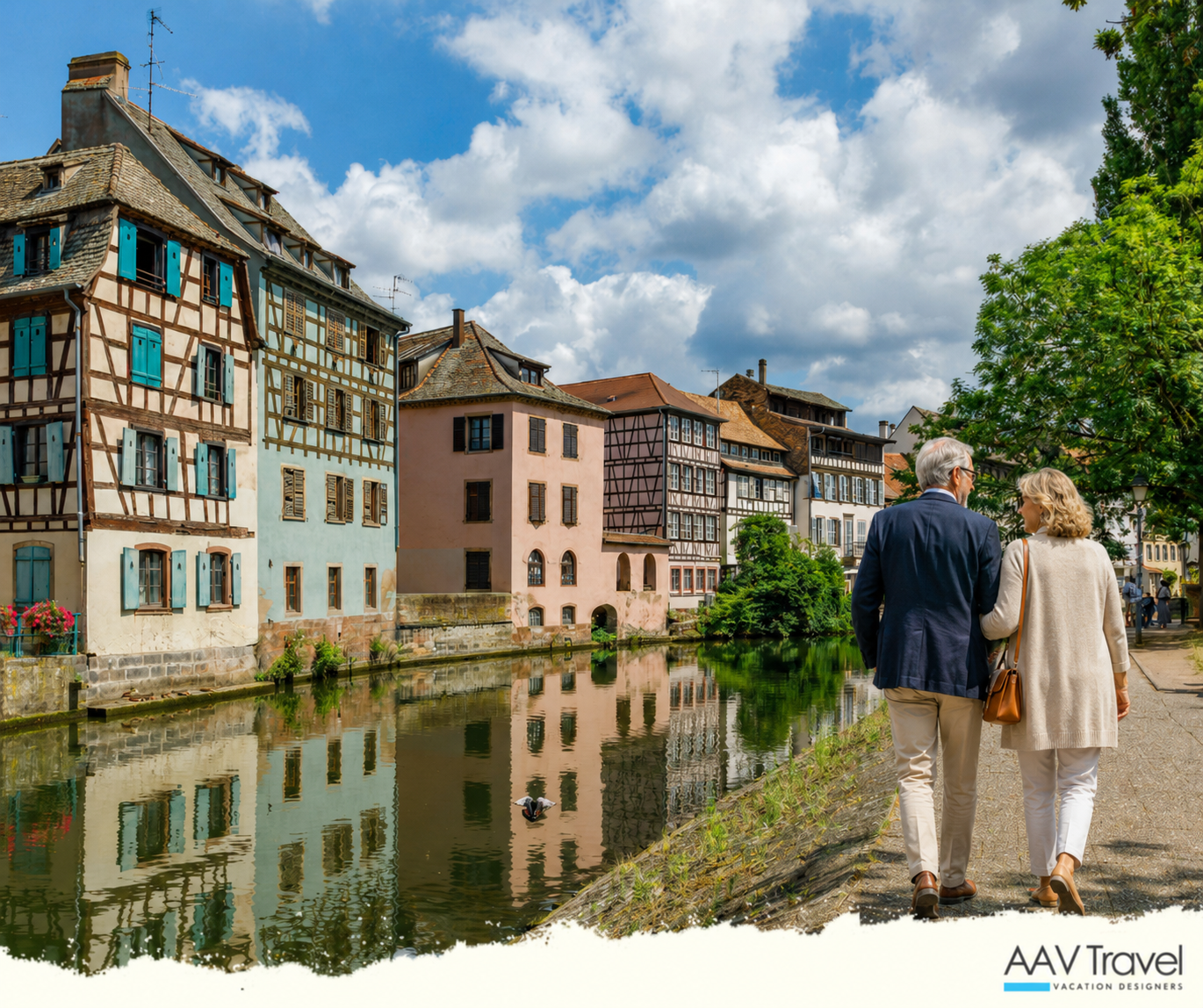
Distance on a map is not always a good guide to how well two places combine, and this is where judgment earns its keep. Stockholm and Helsinki look close enough on paper to make an obvious pairing, yet the crossing between them means either an overnight ferry or a flight with all the airport time that implies. For a traveler who loves the idea of the ferry, that crossing can be part of the trip. For one whose priority is time on the ground in each city, six or seven nights is usually better spent on one of them. London and Edinburgh sit farther apart on the map, yet a direct train covers the distance in roughly four and a half hours, city center to city center, which makes an eight night split quite workable.

It lives in the details: transfer times, arrival patterns, opening days, seasonality, the order in which experiences unfold. When dozens of small decisions like these are made well, travelers rarely notice them. The trip just feels easy.

The pull of the nearby famous place

Once you have crossed an ocean, nearby famous places exert a pull. If we are going all the way to Spain, shouldn’t we at least see Seville? It is an understandable thought, and occasionally the right one. But every addition costs something, paid in the currency the trip has least of. A useful test is whether an addition is something you want to experience, or something you want to have seen. Leaving Seville for another year can be the clearest evidence of good planning, and it hands the next journey its anchor.

Where to spend, where to hold back

La Gemma Florence Italy by AAV Travel

A shorter trip also invites a more selective use of resources. Not everything needs to scale up because the calendar shrank, but a few well chosen investments can meaningfully improve comfort, time, access, or the quality of an experience. The hotel whose location returns an hour of every day. A private transfer on the segment where it truly matters. One exceptional guide for a single morning instead of three ordinary excursions. A cabin that lets you land rested, so the first day belongs to the destination rather than to recovery. The principle is simple: spend where it changes the experience, and hold back where it doesn’t.

Some journeys still need time

None of this argues that shorter is always better. Some journeys need time, and no amount of clever design will change that. A week may be enough to experience one part of New Zealand well, but not enough to approach the country as though you have time for both islands. A first visit to Australia, a multi country itinerary through Southeast Asia, an expedition voyage: these tend to deserve the weeks they require, and the honest advice is often to wait until the calendar can honor them. Sometimes judgment says this trip deserves more time. Sometimes it says you have seven nights, so let’s make them exceptional rather than pretending they are twelve.

A journey does not need to be long to feel substantial. It needs to be edited: a disciplined geography, a clear reason for going, few changes of hotel, experiences chosen rather than accumulated, and enough open space for the place to register. Knowing what to leave out matters as much as knowing what to include, and it tends to be the hardest part to do for yourself.

If a shorter journey is what this year allows, it can be worth having a conversation about how to use that time well before anything is booked. You are welcome to reach out through AAV Travel at www.aav-travel.com or at info@aav-travel.com.

By: Stefanie P.
The Parts of Travel a Camera Cannot Keep

Thousands of travel photos preserve where you went, but not always why it mattered. Discover why a simple travel journal may become the most meaningful souvenir you bring home.


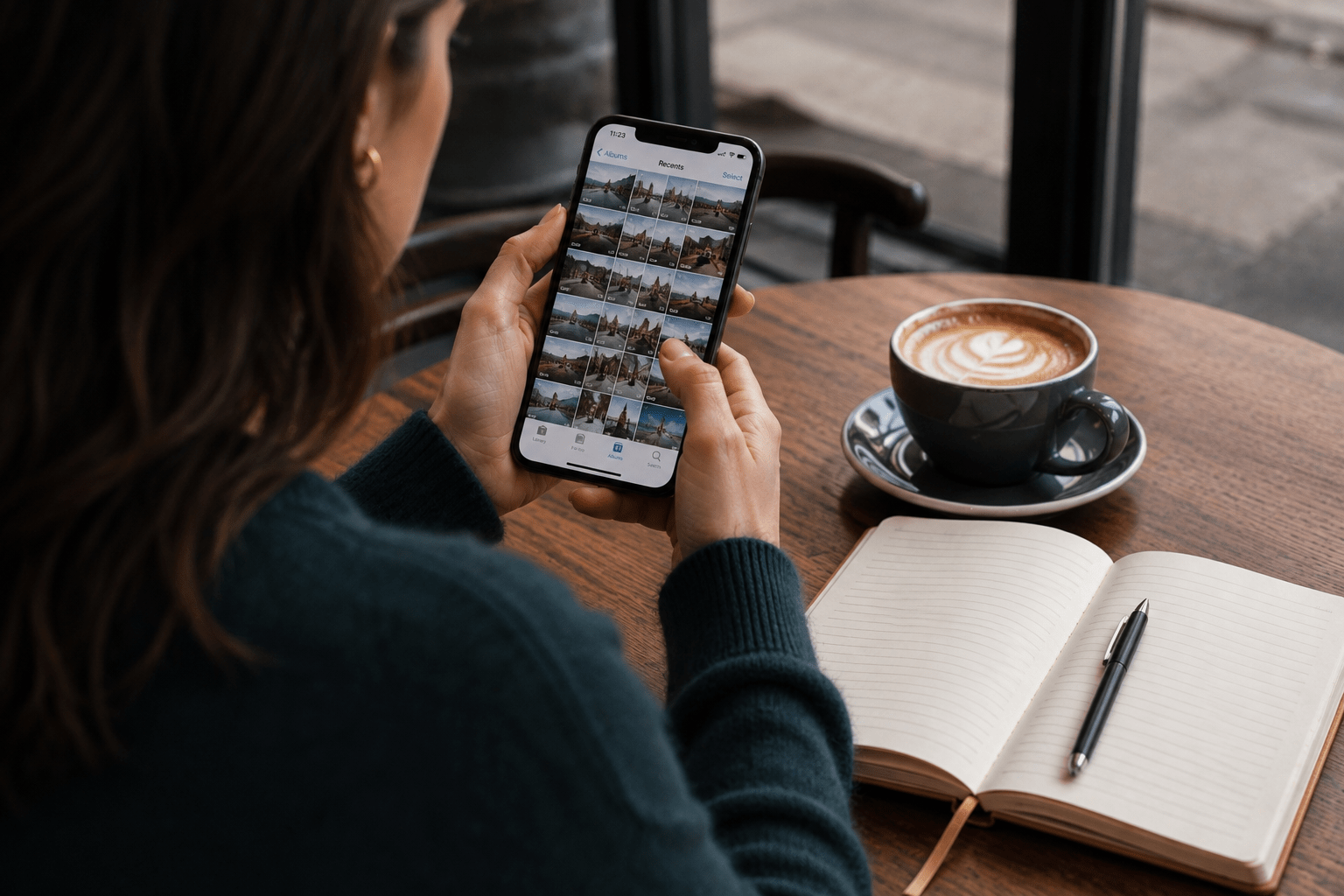
There is a particular moment, usually a few months after a trip, when you open the photo library to show someone a place you loved. You scroll. And you keep scrolling, because somewhere in the two thousand images from that journey is the one that explains it. The harbor at the right hour. The table set for lunch. You find it eventually, and it is a good photograph, and it says almost nothing about why that day mattered.

This is a quiet frustration that experienced travelers know well. We have never documented our journeys more thoroughly, and yet the record we bring home often feels strangely incomplete. The camera did its job. It kept the appearances. What it could not keep was the rest of it, which is to say, most of it.

What the Camera Missed

Think about the moments you actually retell from your favorite trips. Very few of them are visual.

The smell of wet stone in a Périgord village in France after a summer rainstorm. The sound of a village in the South of France at seven in the morning, when the bakery opens before anything else and you can hear it from your window. A conversation with a taxi driver in Dublin that started with directions and ended forty minutes later with his opinions on everything from hurling to his many children. A lunch you nearly skipped, in a place with no sign and no menu, that became the meal you still measure other meals against.

None of those photograph well. Some of them cannot be photographed at all. A camera records light, and much of what makes a journey memorable arrives through the other senses, or through emotion, or through the slow accumulation of small details that only feel significant later. The temperature of the air when you stepped off the train. What you were worried about that week, and how the place gradually took the worry off you.

Ten years on, those are the memories you want back. And they are precisely the ones that fade first, because nothing was done to fix them in place.

Writing as the Second Half of the Record

This is not an argument against photography. Photographs do something writing cannot. They hold exact color, exact faces, the specific way a landscape looked on a specific afternoon. The travelers I work with take beautiful photographs, and they should keep taking them. The argument is for a companion, one that preserves what appearance alone cannot.


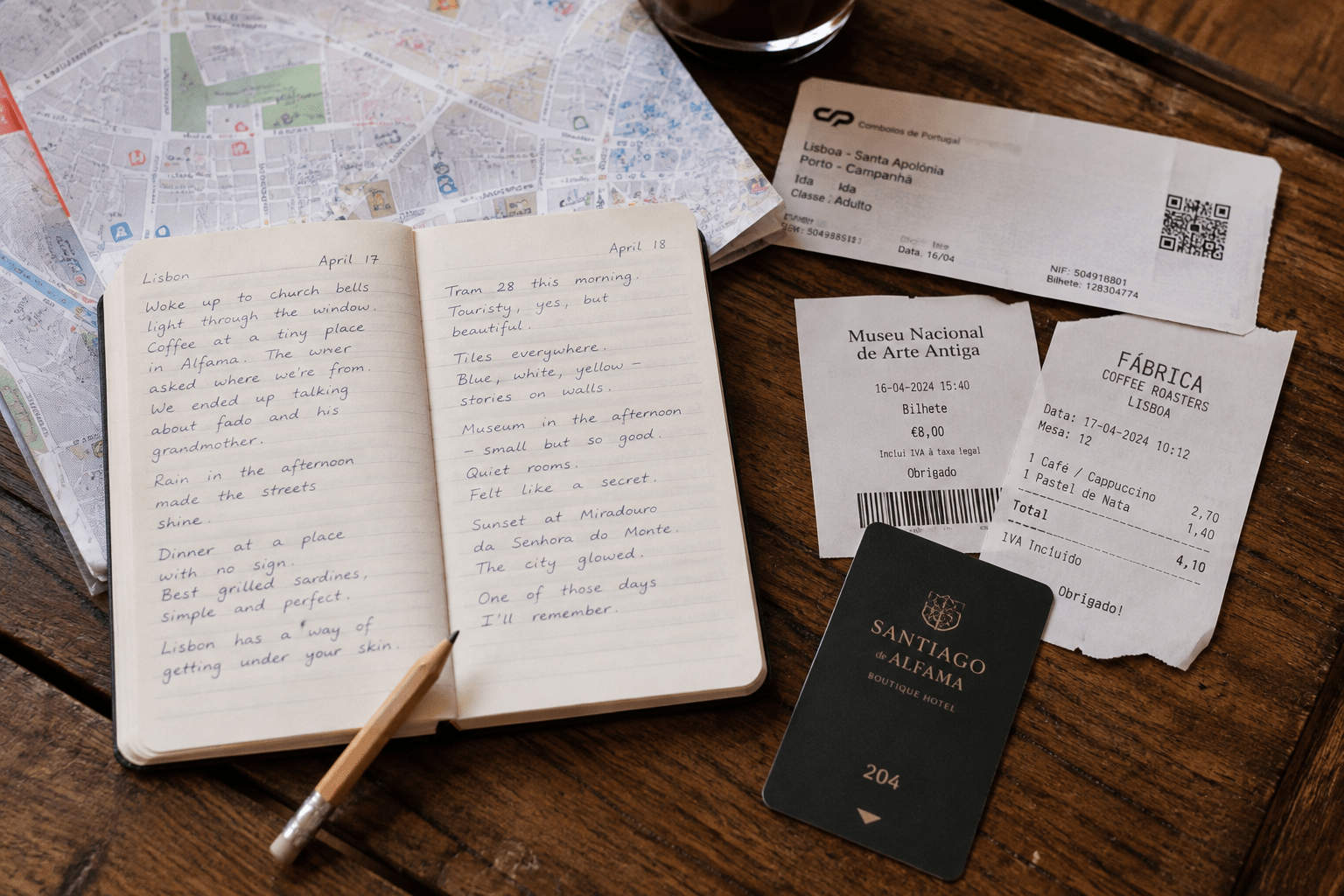
The writing does not need to be good. This surprises people, especially accomplished people who hold their own output to a high standard. A travel journal is a private document with an audience of one, and its value has nothing to do with prose quality. Four sentences at a café table can do the work. What the waiter said. What the light was doing. What you talked about over dinner. What you noticed about yourself that you had not noticed at home. Read those four sentences a decade later and the entire day comes back, in a way that a hundred photographs from the same date somehow do not manage.

I have journals from trips I took more than thirty years ago, and the entries embarrass me slightly, the way old letters do. They also return whole days to me intact. The photographs from those same years have blended into a general impression of places I know I visited. The written pages have not blended into anything. They are still specific.

A Practice of Attention

One reason experienced travelers slow down is that they begin paying attention differently, and journaling both reflects and reinforces that shift. Keeping a journal changes something subtle about the way you move through a place. You begin noticing details that would otherwise pass unnoticed, not because you are searching for something profound, but because you know the day will eventually ask you a simple question: what was worth remembering? Once that question is in the background of your mind, you travel differently.

This is the part of the practice that has almost nothing to do with memory. The photographs and the pages exist for the future. The attention exists for the day itself. You linger in the market instead of walking through it. You ask the vineyard owner one more question. You catch the specific word the fisherman used and hold onto it for an hour, because you can already feel it wanting to be written down.


The journal works on the present as much as on memory. The anticipation of writing a few sentences at day’s end quietly rearranges what you notice while it is still happening. A single careful encounter begins to feel more satisfying than rushing toward the next landmark.

This is why the practice pairs so naturally with slower, more deliberate travel. A journey built around three places instead of nine gives you something to observe deeply. Writing rewards texture, and texture requires time.

Keeping the Practice Small

If any of this resonates, resist the urge to turn it into a system. No prompts, no structure, no obligation to write daily. A notebook that fits in a jacket pocket, opened when something seems worth keeping, is the entire method. Some days produce a page. Some days produce a sentence. Some days produce nothing, and that is information too.

The only real discipline worth borrowing from people who do this well is specificity. Write the name of the restaurant, the words the fisherman used, the exact thing your husband said that made you laugh on the ferry. General impressions fade at the same rate whether they are written down or not. Details are what hold.

Years from now, the photographs will show you what Italy looked like.

The journal will remind you who you were when you saw it.

Perhaps this is one of the quieter goals of thoughtful travel planning: creating journeys with enough space to notice these moments in the first place. That idea has shaped the way I design itineraries for years. The pacing, the timing, and the judgment to leave certain hours unscheduled tend to matter more than any single reservation. If you find yourself thinking about travel this way, about what a trip should feel like rather than simply where it should go, you are welcome to reach out through AAV Travel or contact us directly at info@aav-travel.com.

Written by: Stefanie P.

The Freedom of Knowing You Can’t Do Everything

Most people plan travel as if the supply is unlimited. The assumption is rarely examined and almost never spoken aloud, but it shapes everything. It shapes the overpacked itinerary and the deferred destination. There will always be another trip. Another season. Another chance to reach the place you didn’t get to this time.

For a long stretch of adult life, the assumption is close enough to true that it goes unquestioned. And then, usually without a single event to mark the change, it begins to loosen.

When the question changes

The shift tends to arrive quietly. A traveler who spent their thirties and forties trying to see as much as possible starts to notice a different instinct forming. The itinerary gets shorter before they consciously decide to shorten it. A destination they would have added two years ago gets left off, and the relief of leaving it off is surprising. The question driving the planning has changed, though the traveler may not yet have language for how.

What used to be “how much can I fit into this trip” has become something closer to “what do I actually want from these particular days.”

That is a different question entirely. It produces different answers, different trips, and, for most people who arrive at it honestly, a different relationship with travel.

What the research suggests

Stanford psychologist Laura Carstensen has spent decades studying how people’s priorities shift as their perception of remaining time changes. Her research on time horizons and motivation found something that experienced travelers often sense before they can name it: when people begin to view time as limited, they move toward experiences that carry emotional depth and personal meaning. The pull toward novelty weakens. What intensifies is a desire for experiences that feel genuinely significant, chosen with care.

The traveler who once wanted six countries in three weeks now chooses two weeks in a single region. The scope has narrowed. The clarity has increased.

What selectivity looks like

The changes are often modest. A couple who once built European trips around a country per day begins choosing one region and staying long enough to develop a routine there. Morning coffee at the same café. A walk they take twice because the second time revealed something the first time missed. An afternoon with nothing planned, kept open because the previous afternoon surprised them and they want to leave room for that to happen again.

A traveler who has always sought new destinations starts returning to the same village in the Swiss mountains, or the same coastal hotel in Cornwall. The return visit, which once might have felt like a failure of imagination, now feels like an act of precision. They know what the place offers. They know what it asks of them. They go back because the experience deepens each time, the way a good conversation deepens with someone you know well.

Saying no to a good option is a skill that develops late. Younger travelers rarely practice it, because the assumption of unlimited time makes every deferred destination feel temporary. Experienced travelers learn that declining something genuinely appealing often gives the remaining choices their full weight. A two week trip shaped by four commitments feels different from the same two weeks shaped by two. The difference is in how fully each one can be experienced.

The must-see list contracts. Places fall off. Their removal brings a kind of clarity the traveler didn’t expect. What remains is personal, an honest reflection of who the traveler is and what genuinely interests them. The destinations that hold their place tend to be the ones chosen from genuine curiosity, shaped by interests the traveler has carried for years, sometimes decades.

What constraint makes possible

There is something counterintuitive about limitation producing freedom, but experienced travelers recognize the pattern almost immediately. When every destination is available and every itinerary is open, choosing is difficult. The options don’t narrow themselves. The planning process expands to fill whatever time and attention the traveler gives it, and the result is often exhaustion before the trip begins.

When the supply of trips is understood as finite, the question becomes simpler. Which experiences deserve this particular season of my life? The traveler comparing Norway, Japan, Scotland, and New Zealand often finds that asking what this season of life actually calls for brings an unexpected clarity about which one matters most.

The freedom is in the asking. Once you stop assuming that everything can be deferred, the things that genuinely matter come into focus with surprising speed. What you are left with is greater clarity about what matters. And often, the most satisfying travel you’ve had.

A different kind of conversation

Travelers who reach this point often describe a quiet frustration with the way travel is presented to them. More options. More experiences per day. The vocabulary of travel marketing assumes that abundance is the goal, and for a traveler whose priorities have shifted toward selectivity, that vocabulary has stopped being useful.

Most experienced travelers already have enough information about where to go. What they are looking for is perspective on where their time and attention will be best spent. That requires a different kind of conversation, one that begins with honest questions about priorities, pacing, and what a particular trip needs to do for a particular person at this specific point in their life. It sometimes requires someone willing to say that the most celebrated option on the list may not be the right one.

The best travel decisions made later in life tend to share one quality: clarity about why. The traveler knows what the trip is for. The pace reflects what they actually need. And the trip that results, built on that clarity, is often the most satisfying one they’ve taken.

If you’ve begun to notice that the way you think about travel has shifted, that the old approach no longer quite fits, that shift is worth paying attention to. The most useful starting point is often a conversation about what this season of your life actually calls for, before destinations or dates enter the picture. You are welcome to reach out through AAV Travel or contact us directly at info@aav-travel.com to begin that discussion.

Written by: Stefanie P.

The Flight Choice You Didn’t Know You Were Making

Picture a traveler searching for flights from Chicago to Zurich. Two nonstop options appear, departing within minutes of each other. One is operated by United, the other by SWISS. The aircraft are comparable. The arrival times are nearly identical. The fares differ by less than the cost of a decent dinner near the gate.

Most travelers weighing these two flights compare what booking sites make easy to compare. The price. The seat. The frequent flyer program. The baggage allowance. Almost nobody asks the question that matters most on the rare day when everything falls apart: which passenger protection rules would apply if this flight were significantly delayed or cancelled?

Nothing on the booking screen tells you so.

The choice you did not know you were making

Choosing SWISS does not simply mean different service onboard. It also means the airline assumes a different set of legal responsibilities if your trip is disrupted.

That is the part most travelers never see. Passenger rights on international routes follow two things: where the journey begins, and which airline actually operates the aircraft. The second point matters because the airline that sells your ticket is not always the one operating the aircraft. A flight number beginning with UA can sit on an aircraft flown by SWISS crew, and the reverse happens just as often. When something goes wrong, the operating carrier and the departure point decide which rules you can lean on, whatever the logo on your ticket receipt.

Consider how this plays out on the Chicago and Zurich route.

  • Three passengers leave for Zurich on the same morning.
  • They arrive at the same airport.
  • Their flights cost about the same.

Yet if severe operational problems develop, each passenger could find themselves covered by a different set of legal protections.

Chicago to Zurich, operated by SWISS. European passenger protection rules generally apply, because the operating carrier is European, even though the flight departs from American soil. Switzerland follows the European framework through its air transport agreement with the EU.

Chicago to Zurich, operated by United. European rules generally do not apply. You are covered by American rules and by whatever United has promised in its own policies.

Zurich to Chicago, operated by United. European rules generally apply once again, because any flight departing Switzerland or the European Union is covered regardless of who operates it.

The lesson behind the regulations

Set the rules themselves aside, because the more useful insight is about how travel decisions get made.

Experienced travelers tend to treat two flights as interchangeable when they depart minutes apart, arrive at the same time, and cost nearly the same. By every measure a booking site displays, they are equivalent. Behind the scenes, they can operate under entirely different passenger protection frameworks, and the booking process gives no hint of it. There is no field for it in the comparison grid, no footnote on the fare page, no prompt at checkout.

This is one example of a pattern that shows up throughout travel planning. The information that is easiest to see: schedules and prices and seat maps, is rarely the information that shapes how a trip actually feels when circumstances change. A missed connection in a strange city at midnight is exactly the moment when the fine print you never read becomes the only thing that matters.

Part of thoughtful planning is weighing not only how a trip will go when everything works, but how it will be handled on the occasional day when nothing does. Which carrier operates each flight, where the journey begins, and what happens if the first departure of the day is canceled: these questions rarely change the price of a trip. They can change the experience of it considerably.

One brief caveat belongs here. Whether any protection applies depends on the specific circumstances and the rules in force at the time. European passenger rights continue to evolve through updated regulations, so the exact details may change over time. This is background, and it is never legal advice. For an individual case, ask the operating airline or the relevant aviation authority.

What that means when the phone buzzes at 9pm

Imagine the cancellation notice arrives the evening before departure. Same route, same disruption, two very different evenings.

The passenger booked on a flight covered by European rules holds a defined set of entitlements. In qualifying situations, that can mean fixed compensation, currently between 250 and 600 euros depending on distance, when the cause sits within the airline’s control. It means meals during a long wait, a hotel room if the delay runs overnight, transport to reach it, and the right to be rerouted to Zurich rather than simply refunded and left to start over.

The passenger on the flight governed by American rules holds a firm right to a refund if the flight is cancelled or significantly changed and they choose not to travel. Useful, certainly. But a refund at 9pm the night before a trip to Switzerland is not a trip to Switzerland.

For travelers with prepaid hotels, private guides, cruise departures, or once-in-a-lifetime experiences waiting at the other end, the difference between a refund and a timely rerouting can become surprisingly important.

Beyond the refund, meals, hotel rooms, and rebooking depend largely on what that particular airline has promised in its customer service plan, and those promises vary from carrier to carrier. Some are generous. Some are thin.

Neither system is perfect, and neither is uniformly better. On a smooth trip, the difference never surfaces at all. On a disrupted one, it can decide whether your evening involves a voucher and a hotel shuttle or a long night refreshing a rebooking page.

One question worth adding

The next time you compare two similar international flights, add a single question to your usual list. If these two flights are otherwise alike, which one leaves me better protected if something goes wrong?

The best travel decisions are rarely the ones that attract the most attention. They are usually the quiet ones, made long before departure, that only reveal their value when circumstances change. Choosing between two airlines may seem like a small decision. Occasionally, it proves to have been one of the most important.

If questions like these are the kind you would rather think through with someone who considers them for a living, a conversation is a good place to begin. A Strategic Travel Advisory Session with AAV Travel is designed for exactly this sort of thinking: the timing, pacing, and quiet details that shape how a journey unfolds. You are welcome to reach out at info@aav-travel.com whenever you are ready to start that conversation.

Written by: Stefanie P.

What a bouquet can tell you about the future of luxury travel

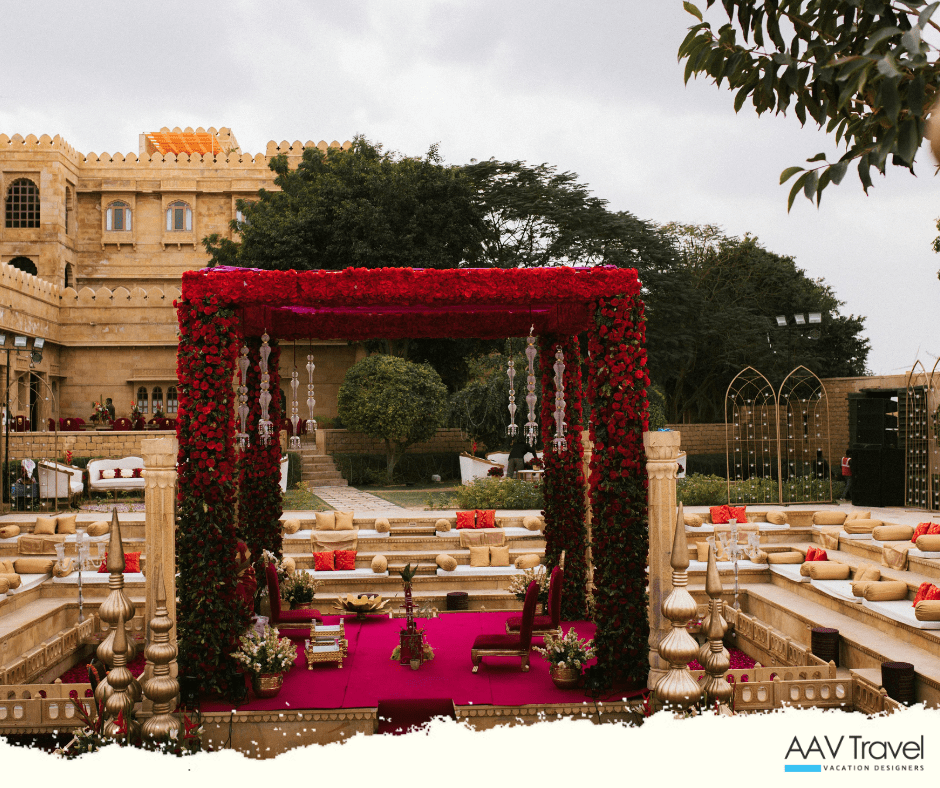
At Leela Palace’s Hotels and Resorts in India, the flowers used for weddings and celebrations do not end up in landfill once the event is over. Instead, they are collected and sent to Phool, a social enterprise that transforms them into charcoal free incense while creating employment opportunities for women from underserved communities.

Most guests will never know this happens. The flowers arrive, the celebration unfolds, and afterward the flowers quietly disappear. It is the kind of detail that reveals something real about how a hotel thinks, even though no one is there to see it.

What happens behind the scenes

Hotels have always competed on what you can see. The room, the view, the restaurant, the service at check-in. Those things matter and they should. But the decisions a hotel makes out of sight often say more about its character than the lobby or the wine list.

A hotel that collects its event flowers and routes them to a social enterprise is choosing to think carefully about what happens after the guests leave. A hotel that invests in a cooling system no one will ever hear about is making a long-term commitment to careful operation. A hotel that builds with stone quarried from its own valley is deciding to belong to a place.

In my experience, hotels that invest this kind of thought behind the scenes often bring the same level of care to the guest experience itself.

The Brando, Tetiaroa

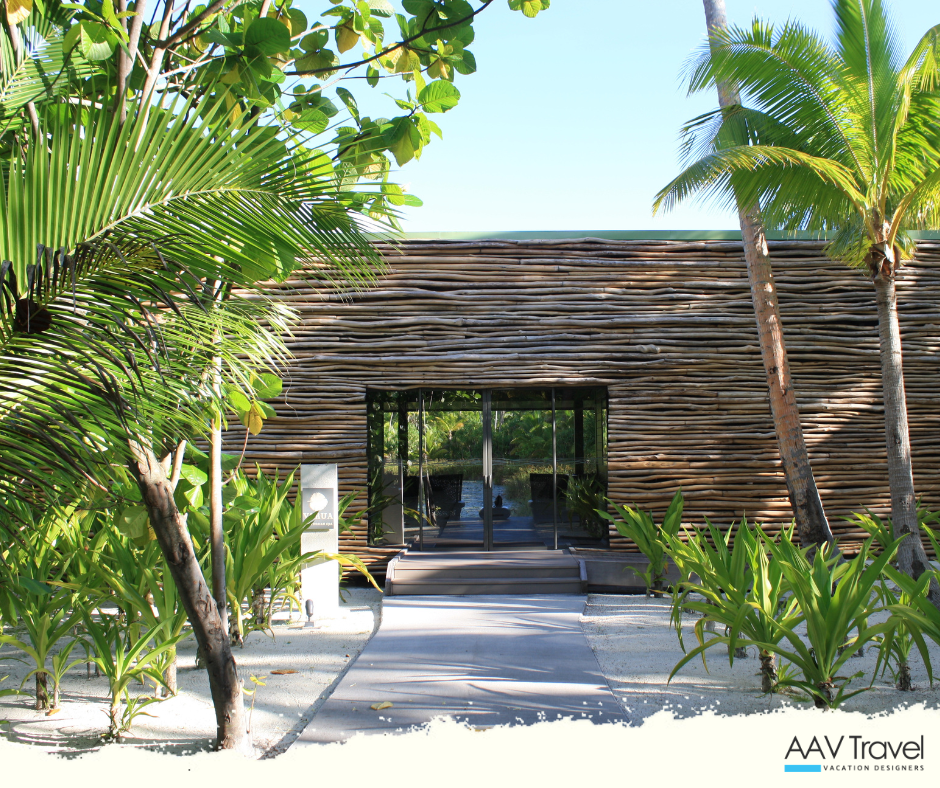
I have spent time at The Brando on Tetiaroa, and the experience changed how I think about what a resort can be. The resort uses a Sea Water Air Conditioning system that draws cold water from the deep ocean to cool its buildings, reducing the energy required for air conditioning by roughly 90%. Food waste is composted within 24 hours and cycled back into the on-site gardens, where produce is grown for the restaurants.

The resort also built an Ecostation on the island and donated it to the Tetiaroa Society, a nonprofit that brings scientists from around the world to study coral reef ecology, sea turtle nesting, and ocean acidification. Guests can visit, though most never do.

Standing on Tetiaroa, I realized that none of these systems announce themselves. Guests simply experience a beautiful resort that feels effortless. That, to me, is the hallmark of thoughtful luxury. The most important decisions often disappear into the experience itself.

7132 Thermal Baths, Vals

Zumthor © 7132 Hotel – Global Image Creation | Jeremy Mason McGraw

Peter Zumthor designed the thermal baths at 7132 in Vals using 60,000 slabs of quartzite quarried from the surrounding valley. The building is set into the mountainside, its grass roof merging with the alpine meadow above it, and its walls carry the texture and color of the landscape they came from.

Bathing here, surrounded by stone that holds light and warmth in equal measure, is one of the most considered experiences I have had in European travel. Everything about the design responds to where it is. The water comes from the St. Peters Spring and emerges naturally at about 30 degrees Celsius. The same source feeds the VALSER mineral water operation nearby. A heat pump captures the thermal energy released when that water is cooled for bottling and redirects it to heat the baths, reducing heating oil consumption by roughly 250,000 litres per year.

7132 Therme Indoor © 7132 Hotel – Julien Balmer

The baths feel the same to the guest whether the heat comes from oil or from recovered energy. The thinking behind it is entirely different. And that kind of thinking, the sort that shapes a guest’s experience without ever drawing attention to itself, is what I look for when evaluating a property for a client.

Where the flowers go

The bouquet at a wedding lasts only a few days. What happens after the flowers fade may seem like a small detail, but those unseen choices often reveal far more about a hotel than the arrangement itself. Increasingly, it is those quiet decisions that distinguish exceptional hospitality from merely beautiful hospitality.

Whether it is recycled flowers in India, deep ocean seawater cooling in French Polynesia, or recovered thermal energy in a Swiss valley, the pattern is the same. The best hotels today are shaped by hundreds of considered decisions that most guests will never see. Knowing which properties operate this way, and recognizing the quieter signs of thoughtful hospitality, is one of the reasons I spend so much time getting to know the hotels I recommend. Those conversations often become part of designing a journey that is truly worth the time.

You are welcome to reach out through AAV Travel or contact us directly at info@aav-travel.com to start that conversation.

Written by: Stefanie P.

Why the Fifteenth Trip Is Usually Better Than the First

How years of shared travel turn informed guesses into genuine understanding.

A few days ago, a text arrived from a client who had just checked in at a resort in Los Cabos. It read, in its entirety: “This place is awesome. The food is exceptional. The room is perfect. Resort only a third full.”

That message took fifteen trips to make possible.

It looks like a note about a resort. I read it as a record of everything that happened before the reservation was ever made: fifteen journeys over more than eight years, and everything those journeys quietly taught me about two particular travelers. Here is the thing about planning travel for someone. People describe themselves as they imagine they travel, which is close to how they actually travel but rarely identical.

Experience compounds. So does understanding.

The myth of the blank page

For a first trip together, the blank page is roughly real. The advisor asks questions, the client answers as best they can, and a plan takes shape from what can be said out loud in an hour or two. Those answers are honest. They are also intentions, and intentions are only a starting point.

Someone tells me they want a full itinerary, then comes home glowing about the one unplanned afternoon spent in a village square doing nothing in particular. Someone insists the hotel barely matters, then mentions, three trips later, that the best sleep of their life happened in a particular room in the Dolomites and they have been comparing everything to it since. A couple asks to see everything a region offers, and the moment they retell for years afterward is a two hour lunch that appeared on no schedule. A client who never once mentioned weather returns from a rainy week in the Scottish Highlands having discovered she loves a landscape in rough weather more than most places in fine weather, and that discovery quietly reshapes her next five trips.

A first planning conversation captures intentions. Only actual travel produces experience, and experience is where the real information lives.

What each journey adds

When an advisor works with someone over many years, each trip becomes part of a larger record. The first trip teaches where a person wants to go. The second begins to reveal how they like to travel, which is a different subject entirely. By the tenth or fifteenth journey, the recommendations rest on years of observation rather than on a questionnaire.

What accumulates is specific.

I learn whether a couple genuinely relaxes into a slow pace or grows restless by the third quiet morning. I learn whether they want a guide who handles everything or whether being handed the car keys and a good map is half the pleasure.

I learn which hotels resonate with them, because hotels have personalities just as people do, and the grand classic property that delights one client can feel like a museum to another.

I learn how much dining matters, and in what form. Some travelers want one unforgettable table per trip. Others want every lunch to be an event. A few would honestly rather have excellent bread, local wine, and no reservations at all.

I learn how much logistics a person can absorb before a trip stops feeling like a vacation.

I learn what balance of discovery and rest actually restores them, as opposed to the balance they believe they should want.

Roadtrip Adventure Iceland

And over enough years, I watch preferences evolve. The couple who once wanted three countries in ten days now want one region, unpacked slowly. The executive who used to treat vacation as a performance now measures a trip by how well she slept. Careers grow more demanding and then, eventually, less so, and what a vacation needs to accomplish changes with each of those seasons.

Almost none of this surfaces in a first meeting. It cannot. It develops the way any real understanding develops, gradually and through evidence.

A familiar pattern in other professions

This is easier to see in fields where people already expect it. A physician who has cared for you for fifteen years reads your test results against everything she knows about your history, your habits, and how you respond to treatment.
An architect designing a third house for the same family already knows how they live, where they gather, and what they said they wanted last time versus what they actually used. Few people would trade that accumulated understanding for a stranger with equal credentials.

Travel works much the same way, even though it is rarely described in those terms. The raw knowledge, the destinations, the properties, the routes, the timing, is the baseline. The understanding of the individual traveler is what turns that knowledge into recommendations that fit.

Accuracy, and how it compounds

I want to be careful with the claim here. The fifteenth trip is rarely better in some objective sense. The first trip I plan for a client can be wonderful, and typically is. What changes over time is precision.

Early recommendations are informed guesses, made carefully. Later recommendations are recognitions.

Some of the sharpest lessons come from the recommendations that land slightly off. A hotel that was objectively excellent but somehow wrong for a particular client teaches me more than five perfect choices in a row, because the conversation afterward surfaces preferences that would never have come up in a planning meeting. A client struggles to explain why a celebrated property left her cold, and in that struggle I learn what she needs a place to feel like. Those misses become part of the record too, and they are often the entries I consult first.

By the fifteenth trip, I spend far less time searching for possibilities and far more time recognizing which of them belongs to this person, at this moment in their life. When a certain resort came across my desk, I already knew these particular clients preferred quiet properties in shoulder season, that food would make or break the week, that they wanted service present but never hovering, and that after the year they had just had, rest outranked everything else. The property matched an understanding that had taken a decade to develop. Once I recognized the fit, the decision was surprisingly clear.

Back to the text message

Reading that message again, it would be easy to conclude that the success came from picking the right resort, and in a narrow sense it did. But the pick rested on fifteen journeys, countless conversations, and years of paying attention to what genuinely restores these two people. The resort was the visible result. The understanding underneath it was the actual work.

What a travel advisor accumulates over a career, more than a portfolio of hotels and destinations, is a growing understanding of the people who experience them.

If this way of thinking about travel planning resonates with you, whether you are weighing a specific trip or simply reconsidering how your journeys come together, a thoughtful conversation is a natural place to begin. You are welcome to reach out through AAV Travel or contact us directly at info@aav-travel.com, and we can talk about what the next journey should do for you.

Written by: Stefanie P.

Why Understanding a Destination’s Rhythm Matters More Than Its Season

On Tetiaroa, a small atoll 33 miles north of Tahiti, there is a moment each year when the Pleiades sink below the horizon and do not return for months. The Tahitians call this period Matari’i i Raro. It is the beginning of the cooler, drier season, and for centuries it has carried a specific cultural weight: a time of scarcity and frugality, when communities slowed down and turned inward before abundance returned.

The atoll quiets during these months. The surrounding water grows calmer. Humpback whales begin arriving from Antarctic waters, traveling north into the warmer shallows around French Polynesia to give birth and nurse their young. On clear nights, with nothing competing, the sky over Tetiaroa is staggering in a way that other seasons, with their cloud cover and humidity, do not quite match. Stargazing belongs to these weeks. So do traditions of oral storytelling and cultural transmission, practices tied to the cooler months when communities turned inward and shared what they carried. The ‘ava ceremony, a ritual with deep roots in Polynesian life that was nearly lost during the missionary period, has been carefully revived and remains part of the seasonal celebrations that mark these transitions.

None of this appears in a climate chart. A traveler researching Tetiaroa for these months would find comfortable temperatures, lower humidity, and less rain. All accurate. All incomplete. The data describes conditions. It says nothing about what the place is actually doing.

Every destination operates on its own calendar, shaped by agriculture, light, migration, spirituality, or tradition. These rhythms determine what a place is doing during any given week, and they can change the character of a visit entirely. Most travelers never encounter them because the usual planning questions, where to go, when the weather is best, how to avoid the crowds, do not surface them. They sit beneath the logistics, invisible until someone who knows the place well enough makes them visible.

The travelers most drawn to Tetiaroa during Matari’i i Raro tend to share something. Their professional lives move fast and leave little room for stillness. Many spend their days moving from one obligation to the next, measuring success through productivity and pace. Even their vacations often carry that same momentum: ambitious itineraries and the instinct to fill every available hour. Part of the appeal of a place like Tetiaroa during these months is that it operates according to a different rhythm altogether. The season invites you to notice more. To sit outside after dinner and watch the Southern Cross move across a sky that has no competition from anything on the ground. To let a conversation with someone from the atoll stretch past its useful point and into something personal. For travelers who have spent decades in motion, that kind of permission can be hard to give themselves. A destination that builds it into its culture makes it easier to accept.

In the Douro Valley of northern Portugal, the grape harvest in September and October changes the region completely. The terraced hillsides that look serene and photographic in June become working landscapes, full of activity and the smell of crushed fruit and the particular energy of a community focused on a single purpose. Producers open their quintas to visitors willing to get close to the process. You sit on a stone terrace at dusk while the day’s picking winds down below, the valley filling with the smell of warm earth, and someone hands you a glass of wine that has not finished becoming itself. The conversation is unhurried. The winemaker’s shoes are still dusty from the vineyard rows. The light over the terraces turns amber and then blue. This is a different thing from the polished tasting room visit available in spring, when the Douro is quiet and beautiful and the vines have not yet begun their work.

Many experienced travelers eventually notice that their most memorable trips share a quality. The weather may not have been ideal. The destination may not have been at its most famous. What made the trip was a feeling of having arrived when the place was doing something true to its own character, something honest and unrehearsed. That feeling is hard to plan for through conventional research, because it depends on knowledge that climate data and crowd calendars do not contain.

In Bali, the Nyepi celebration falls on the Balinese New Year and brings the entire island to stillness. Ngurah Rai International Airport closes for 24 hours. No cars move. Hotels require guests to remain on their grounds. What stays with travelers who have experienced Nyepi is the sound, or the absence of it. Stand on a balcony in Ubud during those hours and you hear insects, wind, water. Nothing mechanical. Nothing human beyond the occasional voice of a child somewhere below. Millions of people, across every village and city on the island, observing 24 hours of collective silence. The experience of being inside that quiet is available once a year, on a date that most international visitors never think to look up.

These rhythms are easy to overlook because they rarely appear in the sources most travelers use when planning a trip. They exist in the specific knowledge of people who have spent years watching a destination change across its own calendar, who have watched how a place changes across its own calendar. The Douro during harvest. Bali in silence. Tetiaroa during Matari’i i Raro. Each is the same place a traveler might visit at another time of year, and each is a different experience because of when the traveler arrived.

The Pleiades will rise again above Tetiaroa later in the year. The whales will move on. The ceremonies of the cooler months will give way to other traditions. A traveler who visits during Matari’i i Raro will carry something from the experience that belongs only to those particular weeks: a sense of having been present for something quiet and intentional, shaped by a rhythm that predates tourism by centuries.

The most meaningful journeys often have as much to do with when a traveler arrives as with where they go. Timing shapes what a destination reveals, what it holds back, and what it offers to someone who is paying attention. That question, when is this place most itself, is worth asking before any itinerary takes shape.

If the timing of a journey is something you have started thinking about differently, or if you have a destination in mind and want to understand when it is most worth experiencing, that conversation is a useful place to begin. You are welcome to reach out through AAV Travel or contact us directly at info@aav-travel.com.

Written by: Stefanie P.

The Best Trips Today May Be the Ones That Leave You Rested

On a long overnight flight, somewhere over the ocean in the small hours, even a seasoned traveler can start to wonder whether the crossing is still part of the pleasure or simply the cost of it. For years, the question never came up. The flight was the price of admission, paid without much thought, and the trip began the moment the wheels left the ground. Lately, for a great many people who have traveled widely and well, that arithmetic has shifted.

The change has nothing to do with a smaller appetite for the world. These are travelers who no longer feel any need to prove themselves through the mechanics of getting somewhere. They have done the overnight flights, the tight connections, and the ambitious itineraries that looked beautiful on paper but required several days to recover from. What they want now is travel that gives more than it takes.

What Luxury Begins to Mean

Early in a traveling life, luxury tends to measure itself in distance and ambition, in how far one has gone and how much was seen. Later, the measure grows quieter and more personal. A room that asks nothing of you in the morning. A view that reveals itself slowly, with no effort on your part. An afternoon with nowhere in particular to be. The plain satisfaction of reaching a place and feeling, almost at once, that it was the right one. Experience has a way of clarifying which parts of travel truly matter and which parts were simply endured.

This is discernment more than retreat, the result of years spent learning what truly rewards the effort. The better question is a simple one. What shape do those ten days leave you in when they are over? Once that becomes the measure, a particular kind of journey starts to make sense.

Four Journeys That Reward a Gentler Pace

Consider the Lowcountry coast of Georgia. Savannah rewards anyone content to wander a few of its squares, sit under the oaks, and let the city arrive over a long lunch. There is real history here and a particular beauty, none of it in any hurry. An easy drive south reaches Sea Island, where the pace slows further still, and a single resort has set the tone for nearly a century. Mornings open onto the Atlantic, afternoons ask for little more than a walk on the sand, and the whole stay unfolds without a time zone to adjust to. For someone who has crossed a great many of them, that absence is its own form of refinement.

Carmel and Big Sur, on the California coast, work on the same principle. Carmel is a town built for lingering, full of small galleries, good food, and a polished calm that never feels staged. The road south into Big Sur is among the most beautiful drives anywhere, and hurrying it defeats the purpose. The catch is that the few genuinely good places to stay along that stretch are small and book many months ahead, which is reason enough to plan it properly. Given a handful of unhurried nights with the Pacific below and nothing on the schedule, the drive itself becomes the point.

For travelers who love big scenery but have tired of the effort of reaching it, the Rocky Mountaineer between Vancouver and Banff is hard to improve on. The whole route runs in daylight, with an overnight hotel stop along the way, so none of the Canadian Rockies passes unseen. You watch it all from a reclining seat under a domed glass roof while someone else handles every detail. No mountain driving, no early scramble to a trailhead, no luggage to move between stops. The landscape does the work, and the traveler simply receives it.

A Great Lakes cruise belongs in the same company. The small ships that sail these waters carry a fraction of the passengers an ocean vessel does, and they call at places with genuine character, from Mackinac Island to the quiet ports of the northern shore. The season is short, roughly May to October, and the late summer light on the water is worth timing a trip around. Days move at the speed of the lake. The scenery stays green and the distances stay humane, and the whole journey sits close to home, with no long crossing and no hard recovery at the end. It is comfort and discovery in equal measure.

The Discipline of Pacing

“A trip does not have to exhaust you to move you.”

What these four journeys share is a sensibility. None of them depends on distance for its appeal. Each values comfort and meaning over the miles covered, and each treats rest as part of the design from the start. And each makes a point that only sharpens with the years. A trip does not have to exhaust you to move you.

Designing travel this way takes a specific kind of attention. It means knowing how a route actually feels day by day, not only how it reads on an itinerary, which accommodations are genuinely restful and which only look the part, and where the natural pauses belong. That is a matter of judgment more than information, and judgment is what accumulates across many years and many trips.

The travelers who get the most from it now tend to be the ones who judge a trip by how well it fits the life they are actually living. That is the wiser measure, and journeys planned that way prove as beautiful and as memorable as anything from the years of going hard and far. The aim is simply to travel well and to come home with something left over.

If you have been thinking about a journey that fits the way you want to travel now, with the pacing and the sense of occasion the moment calls for, a thoughtful conversation is the right place to begin. The most rewarding trips rarely begin with a checklist of attractions. They are designed through careful listening, an honest discussion of pacing and trade offs, and the kind of judgment that comes from years of shaping journeys around what matters most to each traveler. You are warmly invited to reach out through AAV Travel or to write directly to info@aav-travel.com to begin that conversation.

Written by: Stefanie P.

What Makes an Incentive Trip Worth the Investment

An incentive trip carries weight that an ordinary holiday does not. Someone earned it. A company chose to spend real money saying so, in front of the very people it most wants to keep. That changes what the trip has to accomplish. A beautiful setting is the easy part. The harder question is whether the people who arrive feel looked after and glad they work where they do.

Most planning energy goes into the property choice, which makes sense. It is the most visible decision and the easiest to photograph. A property is still only one variable, and on its own it tells you very little about how a group will feel by the third evening.

The personality of a place

I have watched this play out. A company once chose a Caribbean resort for its top performers on the strength of the photography and the brand. The suites were beautiful and the grounds immaculate. Every review glowed. On paper it read as an obvious reward. What the planning missed was the resort’s personality. It was an adults only property built around romance and quiet, full of couples on honeymoon. The noise a sales team makes when the people who hit their numbers are finally together and off the clock had nowhere to go. The group felt slightly out of place among guests who had come for quiet and candlelit dinners, and that mismatch sat under the whole week. Nothing failed outright. By the last night there were no inside jokes and no stories building toward a peak. The week stayed polite.

Every property has a temperament. Some resorts run group business well, anticipating how a group needs to move through arrivals, meals, and a free afternoon without feeling managed. Others, however luxurious, treat a group as an interruption and never quite recover. Size matters too. A group of forty can disappear into a very large resort, never crossing paths at the pool, never forming the running jokes that come from being in one place together.

At a smaller property those same forty people keep bumping into each other, at breakfast, on the beach, in the bar at night, and the trip starts to feel like one shared thing. None of this shows up in a photograph. It comes from knowing how a place actually behaves when a particular kind of group walks in.

Pacing, and the details guests notice

Logistics carry more emotional weight than most companies expect. I once watched a group go to the Amalfi Coast on an itinerary built like a standard sightseeing tour, packed with stops and transfers and dinners spread across several towns. The Amalfi Coast does not move quickly.

The roads are narrow and slow. The towns climb straight up the cliffs, and a distance that looks short on a map can mean an hour of switchbacks behind a tour bus. By midweek the group was tired in a way that had nothing to do with the beauty around them. They had been moved too much. Early starts to stay on schedule, transfers eating the hours in between, and a trip meant to thank them had started to feel like work. Slower mornings, fewer transfers, and two nights in one town instead of one would have sent them home talking about the towns rather than the bus.

These details look minor on a planning document. They are what guests remember. A transfer that runs late. A tired group standing in a lobby at three in the afternoon while the rooms are still being cleaned. A welcome dinner where the seating was clearly an afterthought. None of it gets said out loud, and the guests feel all of it.

Leadership is watching too

The guests are not the only audience. Leadership watches these trips closely. When the room feels flat or people seem worn down, executives notice, and the smoothness of the week becomes a quiet measure of how well the program was run. A recognition trip also tells the rest of the company what gets rewarded and how seriously leadership takes its own promises.

People who did not go hear all about it. The stakes inside the company are real, even when no one says so out loud.

What it means to actually know a property

This is where firsthand knowledge changes the outcome. There is a real difference between selling a resort and understanding how it works for a specific group. Knowing a property means having walked its grounds and watched its staff handle a busy arrival. You learn which rooms are worth requesting and which ones look onto the service entrance. You find out whether the kitchen can put a coordinated dinner in front of eighty people without the courses falling ten minutes behind. None of that is in the photographs. It also means knowing that the Amalfi Coast should be taken two towns at a time and not six, and that a group there to celebrate needs a property loud enough to match them. That kind of judgment comes from years of being in these places and paying attention to what worked and what quietly did not.

What the company gets back

Underneath all of this is a plain business fact. The guests on these trips are often the employees a company can least afford to lose. A week that feels considered does something an annual bonus cannot. The bonus lands in an account and is half forgotten by the next pay cycle. A good trip gets retold for years. A week that feels rushed or mismatched does the reverse, leaving a faint sense that the recognition was more obligation than appreciation. The return rarely shows up neatly on a spreadsheet. It shows up in who stays, in what people say about the company when no one is asking, and in how hard the room works the following year.

The most successful incentive trips rarely happen by accident. They come from planning that accounts for how a group actually moves through a place, from pacing that respects people’s energy, and from choosing a property for how it runs, something no brochure can show. At AAV Travel, incentive travel is approached with attention to exactly those details, because they shape how a group feels long after the trip ends. Companies considering an incentive program are always welcome to start that conversation via info@aav-travel.com.

[Image: an unhurried, aspirational moment, a group lingering over a long table or a serene destination view at dusk, evoking the feeling a well run trip leaves behind.

Written by: Stefanie P.

What Experienced Travelers Have Stopped Asking For

Something has been shifting in the way experienced travelers describe what they want from a journey, and it has been happening quietly enough that the industry has not quite caught up. The vocabulary still reaches for the familiar markers. Suites, butler service, exclusive access, helicopter transfers, the named restaurant, the named brand. Yet the travelers I work with most often, the ones who have spent decades exploring well and spending generously, are increasingly using a different language entirely. They speak of ease. Of feeling understood. Of arriving somewhere and being able to relax into the trip rather than managing the experience.

This is not a rejection of luxury. It is a redefinition of it.

The Distance Between Expensive and Luxurious

There has long been an unspoken assumption that the highest expression of travel is the most expensive version of it. The most expensive suite, the most expensive table, the most expensive private experience. The assumption is not entirely wrong, but it has always been incomplete.

After eighteen years of designing journeys for sophisticated clients, what I have come to recognize is that expensive and luxurious are not synonyms, and they sometimes diverge sharply. A celebrated hotel can deliver flawless aesthetics and still feel impersonal once you are actually inside. A famous restaurant can offer remarkable food in an atmosphere that leaves the traveler feeling oddly transactional. An expensive excursion can be photographed beautifully and remembered without much feeling at all.

What experienced travelers are beginning to sense, often without entirely knowing they are doing so, is that beauty alone is not the same as luxury. Price alone is not the same as luxury. Even exclusivity, taken on its own, is no longer the assurance it once was. Something else is at work, and it is harder to brand because it cannot easily be photographed.

What Travelers Are Actually Remembering

When clients return from a journey and reflect on what stayed with them, the answers are rarely the ones the brochure would predict. They tell me about a quiet conversation with a hotel manager who happened to know exactly what they needed before they could name it. About a morning when the schedule shifted because someone sensed they were tired, and the day became more beautiful for the change. About a meal they cannot fully describe, in a setting that was not particularly grand, that simply landed at the moment they were ready for it.

The pattern across these reflections is consistent. What remains is not the most expensive thing on the trip. It is the moment that felt designed for them. The moment when someone read them correctly and responded with intelligence. The deepest impression a luxury experience leaves is not built from its components but from its attentiveness.

The Quiet Authority of Ease

One of the more interesting shifts I have observed is how much value experienced travelers now place on the absence of friction. Not the presence of features, but the removal of small daily abrasions that accumulate across a trip and quietly erode the experience.

The driver who knows, without being told, that the client prefers not to chat in the early morning. The arrival process that has already been handled before the traveler reaches the desk. The dietary preference that appears at every meal without anyone asking the same question for the third time. The schedule that has built in space for the day a traveler simply wants to do nothing. None of these are luxurious in the way the word is usually understood, nor do they appear in marketing imagery. And yet, taken together, they are increasingly what defines whether a journey feels truly elevated or merely expensive.

The clients I work with rarely use the word seamless when they first describe what they want. They more often describe what they no longer want. Surprises. Logistics they need to manage. The feeling of being a guest who has to ask. What they are reaching for is to be guided through the trip with calm and competence, so that their attention can rest where they actually want it to be.

Pacing as a Form of Refinement

Connected to ease is the quiet emergence of pacing as a marker of considered travel. For years, the implicit assumption in luxury itineraries was that more was better. More destinations, more experiences, more inclusions. The proof of value was measured in density.

That assumption is dissolving among travelers who have spent enough time on the road to know what genuine restoration feels like, and how rarely a fast itinerary delivers it. The new measure of refinement is often the willingness to choose less. Three nights in a single place instead of one. A morning with nothing scheduled. A second cup of coffee on a terrace because the conversation is interesting and there is no reason to interrupt it.

This kind of pacing is unusually difficult to design well. It requires confidence to leave the day open. It requires understanding the rhythm of a destination well enough to know which mornings ask to be filled and which are better left alone. It also requires trust between the traveler and the person planning, because empty time on an itinerary can look, to the untrained eye, like a planning failure. To the experienced traveler, it has become a sign that the person planning understood them.

Personalization Over Performance

There is also a noticeable shift away from travel as a kind of performance. The trip that exists to impress others, that produces certain images for certain audiences, that ticks the boxes of a recognized luxury experience. Some travelers have moved on from this entirely. Others quietly began to suspect, somewhere along the way, that they no longer recognized themselves in those itineraries.

What is replacing it is something more inward. Travel that reflects the actual person taking it, at the actual stage of life they are in, with the particular preferences and curiosities they have developed over time. A journey whose value may not be immediately obvious to anyone except the person taking it.

I have seen this most clearly with clients who arrive at a first conversation already knowing, in some unspoken way, that the trip they are imagining looks nothing like the trips they used to take. The destination might even be the same. Portugal again, or another week in Italy. But what they are describing now is fundamentally different. Fewer people. A slower pace through fewer places. A meal chosen for what they actually want to eat rather than for the name above the door. There is sometimes a slight hesitation when they say it, as though they expect to be talked out of it or redirected toward something more impressive. They are not. That clarity about what they want, earned over years of travel, is precisely the starting point for a journey worth designing.

What this kind of traveler is no longer willing to do is organize a trip around how it will read to someone else. The external markers of a luxury trip are still there, often, but they are incidental rather than primary. The trip is being built from the inside out, and the result tends to be both quieter and more satisfying than anything assembled from a list of recognized names.

The Invisible Architecture of a Good Trip

What all of this points to, in my reading of it, is that luxury is becoming an invisible architecture rather than a visible one. The suite still matters. The restaurant still matters. The destination still matters. But what makes the experience genuinely luxurious is harder to see, because it lives in what was anticipated rather than what was visible, in what was prevented rather than what was provided, in the kind of attentiveness that does not advertise itself.

This is, perhaps, why the gap between luxury branding and genuine luxury experiences has been widening. The branding can keep producing the visible markers, but what increasingly matters to discerning travelers cannot easily be marketed. It shows up only in execution, and only when the person designing the journey has the depth of attention required to deliver it.

There is no universal answer to what luxury means now. The honest observation, after many years of doing this work, is that it has become more individual than ever, more felt than displayed, and more bound up in being understood than in being impressed. The question worth sitting with, before any trip, is not what would qualify as a luxury experience by some external definition. It is what would feel like luxury to you, specifically, at this particular point in your life.

If you have been thinking about a journey and have begun to sense that what you want from it has shifted in ways that are difficult to name, an intentional conversation is often the most useful place to begin. A Strategic Travel Advisory Session is designed for exactly this kind of reflection. Not a list of destinations, but a focused, unhurried discussion about pacing, judgment, and the kind of design that turns a trip into something genuinely your own. You are welcome to reach out through AAV Travel or contact us directly at info@aav-travel.com to begin.

Written by: Stefanie P.