
The Freedom of Knowing You Can’t Do Everything

Most people plan travel as if the supply is unlimited. The assumption is rarely examined and almost never spoken aloud, but it shapes everything. It shapes the overpacked itinerary and the deferred destination. There will always be another trip. Another season. Another chance to reach the place you didn’t get to this time.

For a long stretch of adult life, the assumption is close enough to true that it goes unquestioned. And then, usually without a single event to mark the change, it begins to loosen.

When the question changes

The shift tends to arrive quietly. A traveler who spent their thirties and forties trying to see as much as possible starts to notice a different instinct forming. The itinerary gets shorter before they consciously decide to shorten it. A destination they would have added two years ago gets left off, and the relief of leaving it off is surprising. The question driving the planning has changed, though the traveler may not yet have language for how.

What used to be “how much can I fit into this trip” has become something closer to “what do I actually want from these particular days.”

That is a different question entirely. It produces different answers, different trips, and, for most people who arrive at it honestly, a different relationship with travel.

What the research suggests

Stanford psychologist Laura Carstensen has spent decades studying how people’s priorities shift as their perception of remaining time changes. Her research on time horizons and motivation found something that experienced travelers often sense before they can name it: when people begin to view time as limited, they move toward experiences that carry emotional depth and personal meaning. The pull toward novelty weakens. What intensifies is a desire for experiences that feel genuinely significant, chosen with care.

The traveler who once wanted six countries in three weeks now chooses two weeks in a single region. The scope has narrowed. The clarity has increased.

What selectivity looks like

The changes are often modest. A couple who once built European trips around a country per day begins choosing one region and staying long enough to develop a routine there. Morning coffee at the same café. A walk they take twice because the second time revealed something the first time missed. An afternoon with nothing planned, kept open because the previous afternoon surprised them and they want to leave room for that to happen again.
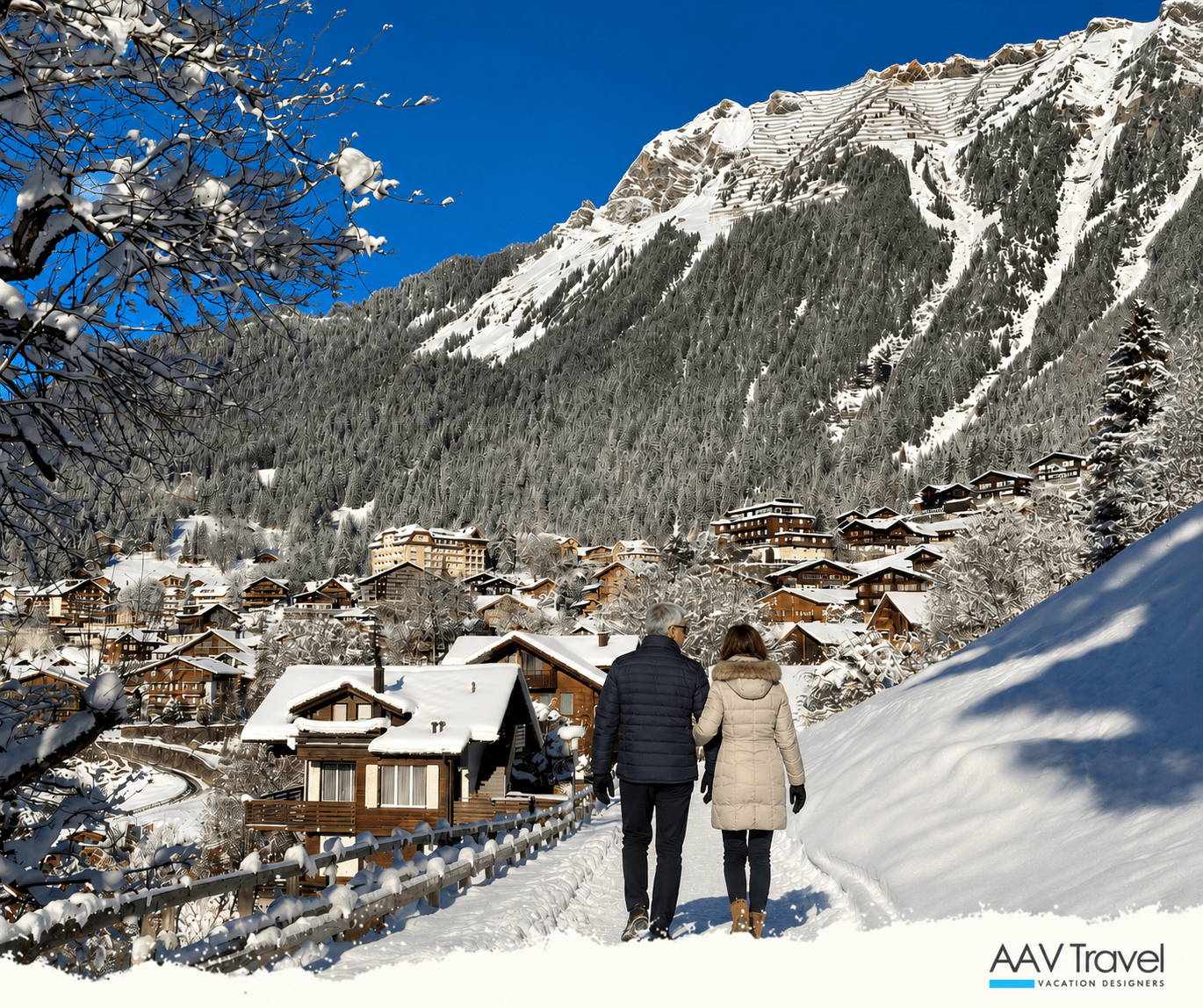
A traveler who has always sought new destinations starts returning to the same village in the Swiss mountains, or the same coastal hotel in Cornwall. The return visit, which once might have felt like a failure of imagination, now feels like an act of precision. They know what the place offers. They know what it asks of them. They go back because the experience deepens each time, the way a good conversation deepens with someone you know well.

Saying no to a good option is a skill that develops late. Younger travelers rarely practice it, because the assumption of unlimited time makes every deferred destination feel temporary. Experienced travelers learn that declining something genuinely appealing often gives the remaining choices their full weight. A two week trip shaped by four commitments feels different from the same two weeks shaped by two. The difference is in how fully each one can be experienced.

The must-see list contracts. Places fall off. Their removal brings a kind of clarity the traveler didn’t expect. What remains is personal, an honest reflection of who the traveler is and what genuinely interests them. The destinations that hold their place tend to be the ones chosen from genuine curiosity, shaped by interests the traveler has carried for years, sometimes decades.

What constraint makes possible

There is something counterintuitive about limitation producing freedom, but experienced travelers recognize the pattern almost immediately. When every destination is available and every itinerary is open, choosing is difficult. The options don’t narrow themselves. The planning process expands to fill whatever time and attention the traveler gives it, and the result is often exhaustion before the trip begins.

When the supply of trips is understood as finite, the question becomes simpler. Which experiences deserve this particular season of my life? The traveler comparing Norway, Japan, Scotland, and New Zealand often finds that asking what this season of life actually calls for brings an unexpected clarity about which one matters most.

The freedom is in the asking. Once you stop assuming that everything can be deferred, the things that genuinely matter come into focus with surprising speed. What you are left with is greater clarity about what matters. And often, the most satisfying travel you’ve had.

A different kind of conversation

Travelers who reach this point often describe a quiet frustration with the way travel is presented to them. More options. More experiences per day. The vocabulary of travel marketing assumes that abundance is the goal, and for a traveler whose priorities have shifted toward selectivity, that vocabulary has stopped being useful.

Most experienced travelers already have enough information about where to go. What they are looking for is perspective on where their time and attention will be best spent. That requires a different kind of conversation, one that begins with honest questions about priorities, pacing, and what a particular trip needs to do for a particular person at this specific point in their life. It sometimes requires someone willing to say that the most celebrated option on the list may not be the right one.

The best travel decisions made later in life tend to share one quality: clarity about why. The traveler knows what the trip is for. The pace reflects what they actually need. And the trip that results, built on that clarity, is often the most satisfying one they’ve taken.
If you’ve begun to notice that the way you think about travel has shifted, that the old approach no longer quite fits, that shift is worth paying attention to. The most useful starting point is often a conversation about what this season of your life actually calls for, before destinations or dates enter the picture. You are welcome to reach out through AAV Travel or contact us directly at info@aav-travel.com to begin that discussion.

Written by: Stefanie P.

The Art of Selective Trust: Why the Best Journeys Begin With Letting Go

There is a particular type of traveler who plans beautifully. They research thoroughly, cross-reference reviews, bookmark restaurants months in advance, and arrive at the airport with color-coded documents and contingency plans for their contingency plans. In their professional lives, this precision has served them well. It has built companies, guided careers, and produced outcomes worth being proud of.

And yet, on the trip itself, something quietly goes wrong. Not logistically. Logistically, things unfold exactly as planned. What goes wrong is subtler. The schedule becomes a constraint. The research becomes a script. The beautiful morning in a medieval village is partially experienced through the filter of whether the next stop will go smoothly. The traveler arrives home rested on paper and quietly exhausted in practice.

Control, when applied to travel with the same intensity it is applied to business, tends to produce a version of the destination rather than the destination itself.

The Illusion of the Perfectly Managed Trip

There is a meaningful difference between being informed and being in command. An informed traveler understands what they want from a journey, what kind of pace suits them, what trade-offs they are willing to make, and what truly matters versus what simply looks good on an itinerary. A traveler attempting to remain in command of every variable is doing something different altogether. They are managing a project.

Travel, at its best, does not behave like a project. It breathes. It offers moments that cannot be scheduled and connections that cannot be engineered. A conversation with a winemaker who decides, spontaneously, to open a bottle that never appears on any list. A morning fog lifting over the Douro Valley at precisely the hour you happened to be sitting on a terrace with your coffee. A sommelier at a small restaurant in Burgundy who, having spoken with you for six minutes, brings something entirely different from what you ordered because he could tell, exactly, what you needed.

These are not accidental moments. They are made possible by the deliberate act of creating space for them.

What Japan Teaches About Trust and Expertise

A well-known observation in hospitality and service design points to Japan as one of the most instructive examples in the world. In Japanese service culture, the customer is not assumed to always know best. Not out of disrespect, but out of genuine expertise. A master craftsman, a seasoned chef, or a deeply trained guide has spent years developing judgment that a visitor, however intelligent and well-prepared, simply does not possess. The expectation of deference flows toward expertise, not toward the paying guest.

This is not a power imbalance. It is a form of respect. It acknowledges that the person who knows the subject most deeply is in the best position to guide the experience. And it produces, in the hands of someone truly skilled, results that the traveler could not have imagined on their own.

The same principle applies to travel design, though it is rarely framed that way in Western contexts where the client is always assumed to be the final authority on their own trip. There is something worth reconsidering in that assumption.

The Real Cost of Overmanaging

When a traveler overmanages a luxury itinerary, the cost is not usually visible. The flight lands, the hotel is beautiful, the driver arrives on time. What is lost is less tangible: the opportunity for the experience to exceed what was anticipated. For something genuinely unexpected to occur within a well-held container.

Luxury travel, at its most effective, is not the elimination of all uncertainty. It is the careful management of risk so that the right kind of openness can exist. An experienced travel advisor does not simply execute logistics. They create conditions for things to go unexpectedly well, which requires a different kind of engagement from the traveler. It requires some degree of trust.

This is a meaningful distinction for travelers who are high-functioning and accustomed to directing outcomes. The ask is not to become passive. It is to redirect the energy that typically goes into control toward something more productive: communicating clearly what matters, being honest about what does not, and then allowing someone with genuine expertise to translate that into a design they could not have built alone.

When Letting Go Produces Better Results

The travelers who tend to describe their trips as transformative are rarely the ones with the most detailed pre-departure research. They are the ones who entered the journey with clarity about what they wanted to feel, and then trusted the people around them to help create that feeling. They did not surrender judgment. They exercised it in a different place. At the beginning, in the design conversation, where it belongs.

A well-designed trip does not require constant intervention from the traveler once it has begun. The structure is already there, built thoughtfully, tested against experience, and calibrated to what the person actually values. When a change occurs, and changes always occur, the advisor is already ahead of it. The traveler does not need to manage the situation. They need only to be present in it.

This is what selective trust looks like in practice. Not blind delegation, not abdication, but choosing deliberately to place confidence in someone who has earned it, so that you can be fully in the experience rather than managing it from a slight remove.

Designing for Openness

The question worth sitting with before any major journey is not how much you know about the destination. It is how much of the experience you are actually willing to receive. Some travelers arrive with every hour accounted for and return home never having been surprised by anything. Others come with a clear sense of what they value, a trusted advisor who understands them well, and enough openness to let the trip become something they could not have planned themselves.

The latter tends to be the more memorable experience. Not because it was less structured. It may have been meticulously structured. But because the structure was held by someone else, someone who understood what it was for and what it was meant to protect.

Expertise is not a service feature. It is a design element. The best journeys are not the ones where the traveler was most in control. They are the ones where control was placed wisely, and then released.

If this way of thinking about travel resonates with you, I would welcome the opportunity to explore what that looks like for your next trip. Through a Strategic Travel Advisory Session with AAV Travel, we can begin with what matters most to you and design from there, with the kind of expertise and judgment that transforms a well-planned trip into an experience that genuinely exceeds expectation. Reach out at info@aav-travel.com to begin the conversation.

Written by: Stefanie P.